
How to Choose the Best Golf Course Mower?
Choosing the right golf course mower affects turf quality, playing conditions, labor costs, and long-term maintenance. A reliable golf course mower should match the course’s grass species, cutting height, terrain, and daily workload. A machine that performs well on a flat fairway may struggle near bunkers, slopes, or narrow approaches.
Begin with the course, not the brochure. Walk the property with the superintendent and note wet areas, uneven ground, tight turns, and frequently missed edges. Reel mowers can deliver a precise, clean cut on closely managed greens. Rotary models may offer greater versatility across roughs and larger fairways. Hybrid and electric options can reduce noise and fuel use, but battery range and charging time require careful planning. These details matter during a busy morning shift.
Operator comfort also deserves attention. Adjustable seats, clear controls, low vibration, and safe visibility can influence productivity over several hours. Ask local dealers for demonstrations, service records, parts availability, and realistic ownership costs. Manufacturer claims are useful, but field experience is stronger evidence. A mower may look efficient on paper and disappoint in wet turf. That happens.
There is no universally best golf course mower. The right choice depends on turf demands, staff skills, budget, climate, and maintenance discipline. Test machines under real course conditions before making a final decision. Record fuel or electricity use, cutting consistency, downtime, and operator feedback. Some preferences may change after one season. That is worth admitting. Good equipment selection is not about finding perfection; it is about reducing avoidable problems while protecting the playing surface.
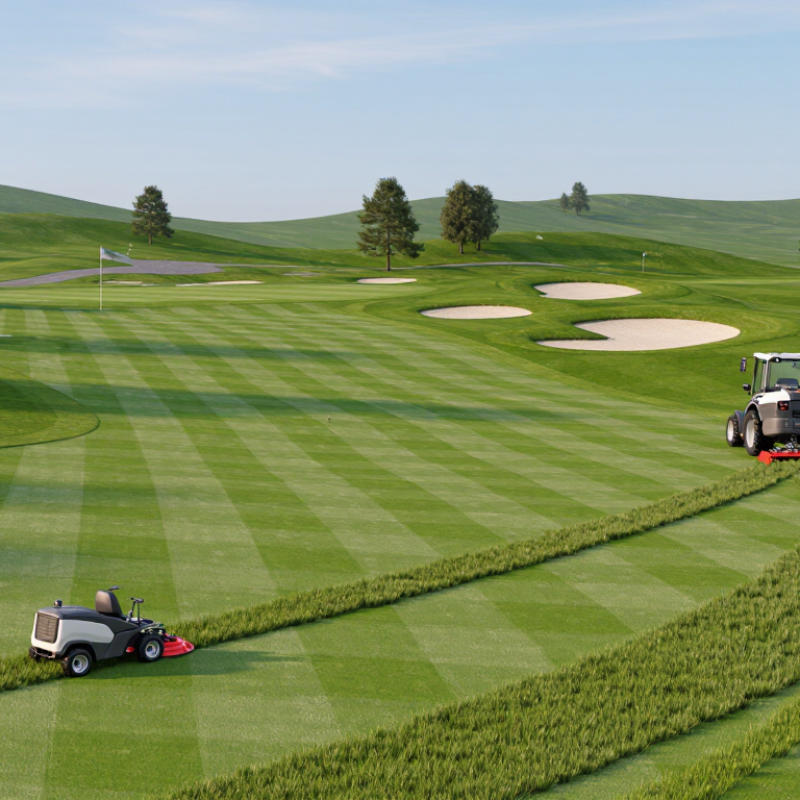
Define the Mowing Needs of Your Golf Course
How to Choose the Best Golf Course Mower?
Define the Mowing Needs of Your Golf Course
A suitable mower begins with the course, not the machine. Walk each area and record its turf type, cutting height, slope, and daily traffic. Greens may require extremely precise cutting, while roughs need durability and wider coverage. Fairways often demand a balance between finish quality and operating speed.
Measure the workload carefully. Note the total mowing area, available labor, and time allowed before players arrive. Morning dew can slow mowing and increase clumping. Wet ground may also create ruts, especially near drainage points. A reel mower can support a fine, uniform finish on closely cut turf. A rotary mower may suit taller grass and less formal areas. The choice depends on the required finish.
Consider the course’s physical details. Narrow paths, sharp turns, bunkers, and tree roots affect mower width and maneuverability. Check the machine’s cutting-height range, weight distribution, noise level, and maintenance access. Operators should test visibility from the seat and control comfort during long shifts. Small discomforts become expensive mistakes.
I have seen schedules fail because mowing time was estimated in perfect weather. That assumption rarely survives a busy season. Build in time for cleaning, blade or reel adjustment, refueling, and unexpected repairs. Keep records of fuel or battery use, mowing hours, surface damage, and cut quality. These details provide stronger evidence than a sales specification. A mower that looks efficient may still be unsuitable for your soil, slopes, or playing schedule.
How to Choose the Best Golf Course Mower? - Define the Mowing Needs of Your Golf Course
| Golf Course Zone | Typical Turf Type | Typical Height of Cut | Mowing Frequency | Recommended Mower Category | Important Mower Requirements | Main Selection Priority |
|---|---|---|---|---|---|---|
| Putting Greens | Fine-textured creeping bentgrass, annual bluegrass, or similar fine turf | Approximately 2.5–5 mm | Daily during active growing periods; often 5–7 times per week | Walk-behind precision reel mower | Very accurate height adjustment, sharp reel and bedknife, low turf compaction, consistent clip frequency, and excellent contour following | Cut quality and surface smoothness |
| Green Surrounds and Approaches | Fine turf and closely maintained transition grass | Approximately 6–15 mm | Usually 3–6 times per week, depending on growth and presentation standards | Light triplex reel mower or contour-following rotary mower | Good maneuverability, narrow turning radius, adjustable cutting height, and low risk of scalping on slopes | Maneuverability and transition quality |
| Tees | Dense cool-season or warm-season turf maintained for a clean playing surface | Approximately 6–12 mm | Usually 2–5 times per week during the growing season | Triplex reel mower or compact fairway reel mower | Consistent height, compact dimensions, low turf marking, easy transport between teeing areas, and reliable operation around obstacles | Consistency and access |
| Fairways | Dense turf such as perennial ryegrass, fine fescue, bentgrass, bermudagrass, or mixed fairway turf | Approximately 10–20 mm | Generally 2–4 times per week during peak growth | Multi-unit fairway reel mower; rotary mower may be used where finish requirements are lower | High daily productivity, stable traction, uniform clip, low ground pressure, good visibility, and sufficient fuel or battery capacity for long work cycles | Productivity and uniformity |
| Primary Rough | Longer maintained turf, often including mixed grasses and areas with variable density | Approximately 25–50 mm | Typically 1–2 times per week, adjusted for seasonal growth | Wide-area rotary mower or rough mower with rear discharge or collection options | High cutting capacity, strong power reserve, durable deck, good slope stability, adjustable height, and resistance to uneven ground | Capacity and durability |
| Intermediate and Native Rough | Naturalized grass, taller turf, and areas with mixed vegetation | Approximately 50–100 mm or managed selectively | Every 1–4 weeks, depending on play strategy, weather, and environmental objectives | Heavy-duty rotary mower, flail mower, or selective mowing equipment | Robust cutting system, protection from stones and debris, strong traction, safe operation on irregular terrain, and easy deck cleaning | Safety and terrain capability |
| Practice Areas | Turf maintained for repeated player use, including practice fairways and landing areas | Approximately 10–25 mm, depending on the area | Usually 2–5 times per week during peak use | High-productivity fairway reel or rotary mower | Wide cutting width, simple height adjustment, efficient transport, dependable uptime, and low operating cost per acre | Operating efficiency |
| Slopes, Banks, and Restricted Areas | Turf on gradients, narrow corridors, drainage edges, or areas near hazards | Approximately 15–75 mm, depending on the zone | Based on growth rate, visibility requirements, and access limitations | Compact walk-behind, remote-controlled, or slope-capable rotary mower | Low center of gravity, dependable braking, rollover protection where applicable, controlled ground speed, and reduced operator exposure to hazards | Operator safety and stability |
| Selection rule: Start with the zone requiring the highest finish quality, the actual height of cut, weekly mowing area, terrain conditions, available labor, and expected operating hours. Reel mowers generally provide the most precise finish on closely maintained turf, while rotary and heavy-duty machines are typically better suited to taller or less uniform grass. | ||||||
Related Posts
-
Revolutionizing Golf Course Care: The Ultimate Guide to Choosing the Right Lawn Mower
-
Top 10 Small Utility Tractors for Efficient Farming and Gardening
-
10 Essential Tips for Choosing a Small Tractor with Loader?
-
What is a compact tractor and how it revolutionizes modern farming globally
-
The Ultimate Guide to Choosing the Right Mid Size Tractor for Your Farming Needs
-

Exploring Unique Applications of Round Balers in Modern Agriculture